
ISO/IEC/IEEE 24748-7000:2022
Valuebased EngineeringFrom digital humanism to value-based AI system design
A strategic thinking method for data and AI projects that puts human values at the start and translates them into verifiable requirements.

Foundation
What Valuebased Engineering is
Valuebased Engineering integrates human values systematically into the development of data and AI systems. It closes the gap between ethical guidelines, legal requirements and practical system design.
Classical engineering methods are oriented towards function, efficiency and technical performance. Those aspects remain important. Valuebased Engineering adds the question of which values are affected and how the effect on those values can be evidenced.
Ethical value analysis
The work starts with an analysis of the values at stake through three lenses: utilitarian, virtue and deontological.
Stakeholder centred
Every relevant stakeholder is identified and involved, so that their value expectations reach the system itself.
Concrete system requirements
Abstract principles become Ethical Value Requirements (EVRs) that guide the development process.
Anticipatory risk management
Ethical risks surface early and are treated while a change is still inexpensive.
Process
Four steps in the VbE process
1
Concept and context exploration
Understand the operational context and the stakeholder landscape, identify value expectations and possible effects.
2
Value elicitation and prioritisation
Gather the ethical values of stakeholders, order them with established ethical theories and translate them into EVRs.
3
Risk-based design
Run the risk analysis and demonstrate that the system holds the EVRs that were defined.
4
Transparency management
Explain which value-based functions sit inside the system — proactively, understandably, verifiably.
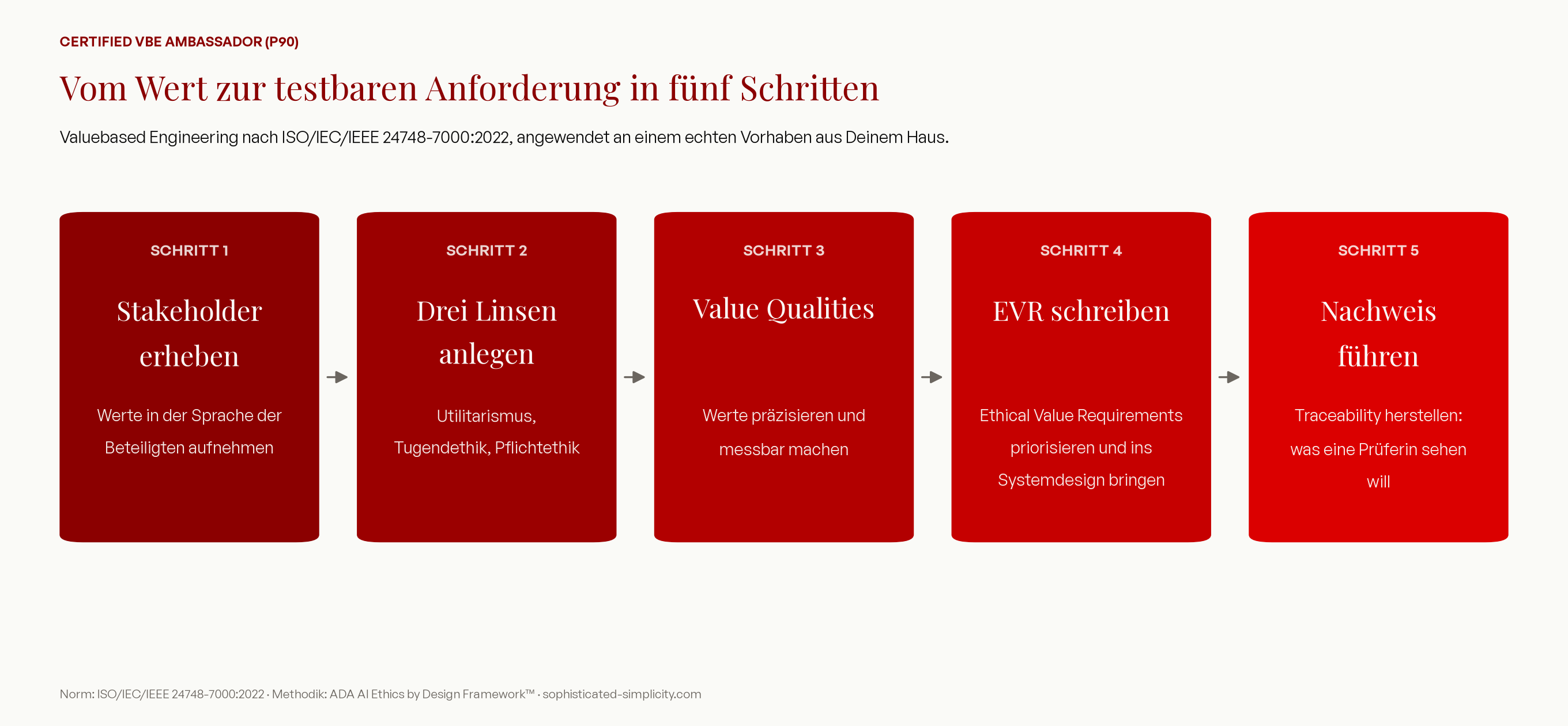
The method at a glance
From stakeholder values to verifiable requirements
Five steps of value elicitation, carried by the VbE foundation. Each step answers exactly one question and leaves an evidence trail.
VALUE ELICITATION & EVR DEVELOPMENT
From values to verifiable requirements for trustworthy AI
STAKEHOLDER PERSPECTIVES
Whose values, needs and expectations matter?
VALUE QUALITIES
What qualities of impact do we care about?
CORE VALUES
Which values are non- negotiable?
ETHICAL VALUE REQUIREMENTS (EVRs)
What must our AI system achieve?
THREATS & RISKS
What could compromise our values?
THE VbE FOUNDATION (ISO/IEC/IEEE 24748-7000:2022)
- ETHICAL LENSES
- Utilitarian Virtue Deontological
- CONTROLS
- System Controls Organizational Controls
- KPIs
- What gets measured gets managed.
- QUALITY GATES
- Decision points for accountability and oversight.
- CONTINUOUS LOOP
- Monitor – Learn – Adapt – Improve
Valuebased Thinking is the DNA of ADA: I design AI systems that create value, minimise harm and earn trust.
Why it matters
Two in three digital initiatives fail when they meet reality.
Valuebased Engineering turns organisational values and stakeholder requirements into measurable outcomes through context-specific AI system design.
The outcome is an MValP — a Maximum Valuable Product. At the beginning stands a MinValP, after iterations a MaxValP. The distinction from the MVP of design thinking is deliberate: there viable, here valuable.
- Investment certainty for your AI initiatives
- Systems that still hold up in two years
- Anticipatory strategy work, before repair becomes necessary
- Protection for the values your organisation stands for
- Preparation for the requirements of the EU AI Act
- An evidence trail for audits aligned with ISO/IEC 42001
The chain of evidence
- 1StakeholderWhose values count in this context?
- 2Value qualityWhat quality should the effect have?
- 3Core valueWhich values are non-negotiable?
- 4EVRWhat must our AI system deliver?
- 5ThreatWhat could damage these values?
- 6ControlWhich measure holds against it?
- 7KPI with baselineWhat is measured, and from which starting point?
- 8Governance corridorWho decides, who is accountable, who looks?
ADA AI Ethics by Design Framework™
Three phases, twelve Building Blocks, three Quality Gates
ADA is a structured thinking method for the anticipatory and value-oriented development of AI agents and companions with integrity. At the end of each phase stands a shared Quality Gate: a decision that is reasoned and evidenced.
ADA on goodsouls.AI ↗ACT
Logos
ROI¹ INTEGRITY
DESIGN
Ethos
ROI² IMPACT
ALIGN
Pathos
ROI³ INVESTMENT
Certification
Certified VbE Ambassador
Three intensive days of training, online from 21 to 23 January 2027: generative AI, ethical principles, systematic risk management through ethics by design, value-based system prompts and practical work with the EU AI Act.
I developed the certificate “Valuebased Engineering Ambassador” together with Austrian Standards. Personnel certification follows ISO/IEC 17024. The fee is €3,190 including 20% VAT (€2,658.33 net); the examination fee at Austrian Standards is separate. Dates and enrolment run through the Valuebased AI Academy.
Reference
What clients say
“I very much enjoyed working with Sabine on datahub.tirol. The way she approaches things, analyses them strategically and immediately thinks in win-win terms helped us a great deal with our data and AI use cases, with business modelling and with finding the USP of datahub.tirol. I can recommend Sabine warmly, above all on the subject of Valuebased Engineering.”
Keynote, Academy or an AI project?
Tell me what is on the table. I reply with an assessment.